The WWE Intercontinental Championship belt has a strange claim to fame. It is one of the most beloved titles in wrestling, it has launched more main-event careers than almost any other belt, and it has never once been the top title in the company. That contradiction is exactly why collectors care about it.
First defended in 1979, the Intercontinental Championship is the third-oldest title still active in WWE, behind only the WWE Championship and the United States Championship. Over four and a half decades it has been redesigned repeatedly, and each version has its own following. This guide covers what the belt is, how the design changed across eras, and what to look for if you want a replica title belt of your own.
What Is the WWE Intercontinental Championship Belt?
The Intercontinental Championship is a secondary title, historically contested in the midcard rather than the main event. Calling it secondary undersells it, though. It has long been described as a stepping stone to the WWE Championship, and the list of people who held it on the way up reads like a Hall of Fame roll call.
The title was established by the then World Wrestling Federation on September 1, 1979. In storyline terms, Pat Patterson unified the WWF North American Heavyweight Championship with a South American Heavyweight Championship after winning a tournament in Rio de Janeiro. Wrestling historians widely agree that tournament never actually happened. It was a way to explain a new belt. Either way, Patterson was the inaugural champion, and the name came from merging those two continental titles.
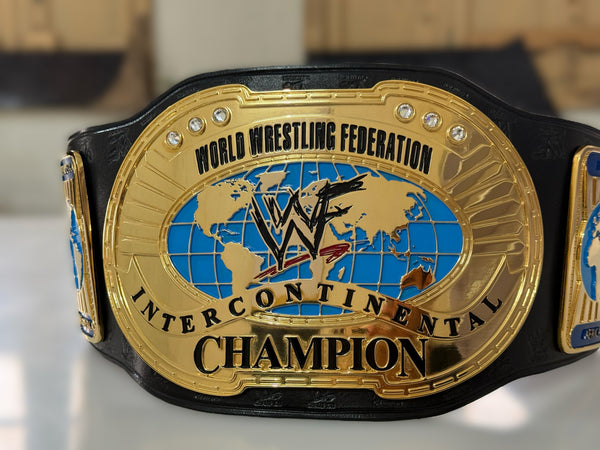
The word "intercontinental" originally referred to North and South America. When the belt was redesigned in 1985, the center plate changed to feature a globe centered on the Atlantic, taking in western Africa and Europe, to reflect a wider reach. For the complete origin story, the record holders, and how the title evolved decade by decade, see our Intercontinental Championship history.
The Design Eras, and Which One You Want
This is the part that matters for a collector, because "the Intercontinental belt" is not one object. It is at least six distinct designs, and which one someone means usually depends on when they started watching.
The Original (1979 to 1984)
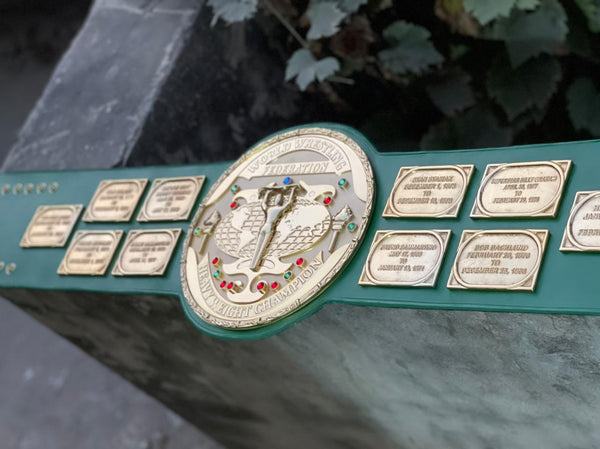
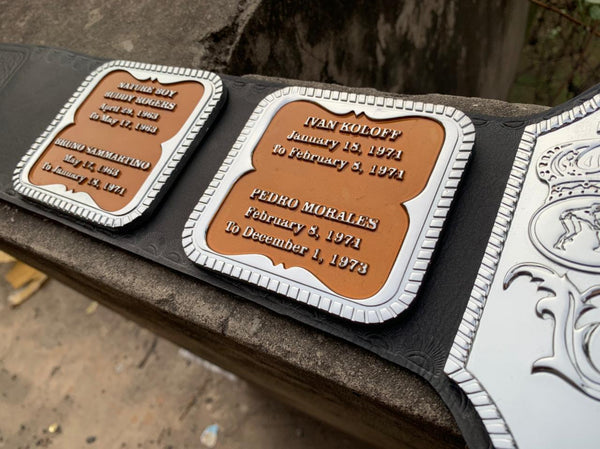
The first design is the most historically important and, by common consensus, the least attractive. The strap was thin and the plate was small. Legends like Patterson and Pedro Morales held it, but it is very much a product of its era. It lasted about five years before being replaced.
For a collector, the original is a purist's pick. It is not the one most people picture, and it is not the strongest display piece, but it is where the lineage starts.
The Classic Design (1985 to late 1990s)
This is the one most fans mean when they picture the Intercontinental title. The 1985 redesign introduced the globe center plate, and with a black strap it became one of the most iconic championships in wrestling. Randy Savage, Bret Hart, Shawn Michaels, Mr. Perfect, and Ultimate Warrior all defined themselves with this version.
Some wrestlers swapped the strap color. Ultimate Warrior famously used a yellow strap. Opinions vary on whether that helped. The colored straps leaned toward the entertainment side and, to a lot of collectors, made the belt look slightly more like a toy. The black-strap version is the safe default and the one most reproductions target.
The Attitude Era Oval
Through the late 1990s the belt carried the look most associated with the Attitude Era boom, the period when wrestling was at its cultural peak. This is a heavily requested version precisely because of nostalgia for that era. It is the belt that was around when "Stone Cold" Steve Austin, who also held the Intercontinental title earlier in his run, was the biggest star in the business. If the Attitude Era is your entry point, our guide to the Smoking Skull belt and Stone Cold's custom title covers that period in depth.
The Modern White and Gold (2019)
In late 2019 WWE unveiled a dramatic redesign, gifted on screen to then-champion Shinsuke Nakamura. It replaced the long-standing look with a white leather strap and a large gold center plate. It was divisive at first and then grew on people. If you want the white intercontinental championship belt, this is the design you mean.
The Newest Design (2024 onward)
In September 2024 the title was redesigned again, with Bron Breakker winning the new version at SummerSlam. It is the current look and the one on television now. Recent champions have included Bron Breakker, Jey Uso, Dominik Mysterio and Penta, and Jey Uso's reign brought a further cosmetic tweak with blue accents.
Because the current design is still evolving on screen, reproductions of it vary in how up to date they are. If you specifically want the newest version, check the reference images against a recent broadcast rather than assuming.
How the Intercontinental Belt Compares to Other Titles
People shopping for an Intercontinental replica are often really deciding between it and one or two other belts. A quick orientation.
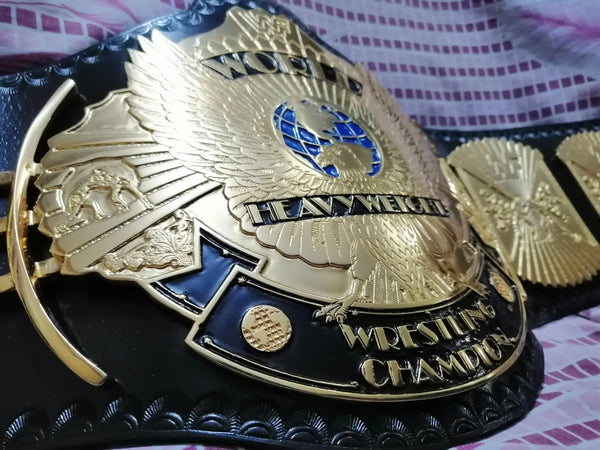
Against the main WWE Championship, the Intercontinental is the more affordable and, to many, the more nostalgic choice. The main title, especially the Winged Eagle design, is the flagship, but it is also the most reproduced and the most generic as a result. The Intercontinental has more visual variety across its eras.
Against the United States Championship, the other great secondary title, it comes down to allegiance and era. Both are midcard belts with long histories. Our United States Championship guide covers that side if it is the one you are drawn to.
There is also now a separate Women's Intercontinental Championship, introduced in 2025, which is its own distinct title with its own design. It is worth knowing it exists so you do not confuse the two when searching.
What Separates a Good Replica from a Bad One
The Intercontinental belt, in most of its designs, is a detailed piece. The globe, the lettering, and the side plates all carry fine work, and cheap reproductions lose that detail fast. The things that matter are the same ones that separate quality on any championship belt.
- Plate thickness. Thin plates cannot hold crisp detail and they flex. Look for real thickness rather than a stamped sheet.
- Engraving quality. The globe and the raised elements need clean definition. On a soft reproduction the map detail blurs into the background.
- Plating. Gold plating over a zinc base is standard. Evenness is what varies, and poor plating dulls the contrast the design depends on.
- Strap. Genuine leather versus synthetic, and it matters more if the belt will be worn rather than mounted. The white 2019 design in particular lives or dies on strap quality, because a cheap white strap looks cheap immediately.
- Weight. A well-built belt is heavy. If it feels light, the plates are thin, whatever the listing says.
We go deeper on all of these in our breakdown of championship belt materials and craftsmanship, which is worth reading before any belt purchase.
One detail specific to the Intercontinental belt is the side plates. On the current design, the official version uses swappable side plates, letting the owner change the smaller plates flanking the center. Some reproductions copy this, some do not. If interchangeable side plates matter to you, confirm it before buying rather than assuming, because a fixed-plate reproduction cannot be changed later. On the classic designs the side plates are fixed, and there the thing to check is simply that their detail matches the center plate in quality, since a sharp center plate paired with soft side plates is a common tell of a rushed reproduction.
Budget, Mid-Range and Premium
Roughly how the tiers break down for an Intercontinental replica:
- Budget. Thin plates, often stamped, synthetic straps. Fine for a costume, a young fan, or a wall piece viewed from across a room. The globe detail will be soft.
- Mid-range. Thicker plates, better plating, genuine leather. This is where most serious fan purchases sit, and where the design actually reads correctly.
- Premium. Heavy plates, deep engraving, high grade plating, well-finished leather. The globe and side plates come through sharply. This is the display-and-keep tier.
Choose by use. A gift or a wall mount is comfortable at mid-range. A serious collection or anything that will be handled repeatedly justifies premium. If you plan to display it, our guide to championship belt display options covers mounting.
Sizing, Fit and Wearability
One thing product listings rarely explain clearly is size, and it catches buyers out. A championship belt is not one length.
Adult replica belts are typically built to fit up to roughly a 50-inch waist, with snap studs along the strap so the fit adjusts down. That range covers most adults comfortably. The thing to check is how the adjustment works: cheaper belts sometimes offer only one or two positions, which can leave the fit awkward.
If the belt is a gift for a child, look specifically for a youth or kids version rather than assuming an adult belt will adjust down far enough. It usually will not sit right on a small frame. Some makers offer a one-time-adjustable strap sized for children, which is a different product from the adult replica.
There is also a real difference between a belt built to be worn and one built to be displayed. A worn belt needs strong strap hardware and secure snaps, because it gets put on and taken off repeatedly. A display belt can prioritize plate detail and finish over strap durability. Decide which one you are buying before you compare prices, because they are not really the same object.
Who Buys an Intercontinental Belt
The Intercontinental design suits several different buyers, and knowing which one you are helps narrow the choice.
- Collectors. Usually after a specific era's design, often the 1985 classic, and willing to pay for plate detail and a proper strap. For this buyer, fidelity to the original is everything.
- Gift buyers. Buying for a fan whose favorite era you know. The reaction comes from recognition, so matching the right design matters more than squeezing out the last bit of quality.
- Cosplayers and performers. Need the belt to look right on camera and survive being carried. Strap and hardware move up the priority list.
- Gyms, promotions and events. Not usually after a straight replica at all. They want the Intercontinental look adapted into something with their own branding, which moves the conversation toward a custom build.
That last group is worth expanding on, because it is where a replica stops being a replica.
Custom Belts Inspired by the Intercontinental Design
The Intercontinental belt is a popular reference point for custom work. Its globe center plate and side-plate layout translate well into an original design, and a lot of gyms, local promotions, and award programs want exactly that feel without copying the title outright.
A custom build based on the general look lets you keep what makes the design read as a championship, the substantial center plate, the classic proportions, while swapping in your own logo, event name, or a nameplate. The practical decisions are the ones that matter on any custom belt:
- Whether the nameplate is fixed or replaceable, which matters if the belt passes between champions.
- Whether your logo artwork is clean enough to engrave at plate size, which usually means a vector file.
- Whether it is a single belt or a run for a league or tournament.
- How long you have, since custom work takes time and is not an off-the-shelf purchase.
The custom title tradition in wrestling itself runs deep, from Stone Cold's Smoking Skull to John Cena's spinner. Our guide to custom championship belts in wrestling covers how personalized titles became normal, which is useful background if you are commissioning your own.
Buying an Intercontinental Replica from MS Belts
MS Belts produces replica-style Intercontinental designs as part of a wider WWF championship belt range, and we can also build custom championship belts inspired by the classic look with your own nameplate or logo. We are one of a number of makers offering these, so the sensible approach is to compare on plate thickness and engraving depth rather than on price alone.
If you want a specific era's design, tell us which one, because as this guide shows, "the Intercontinental belt" can mean six different things. To start a build or ask about a specific design, use our custom belt builder, or contact us for a quote for bulk or event orders.
One practical note on timing: a custom build takes longer than a design from the shop, because the design has to be approved first. If you are buying for a birthday, an event, or the holidays, order with margin. Custom engraving and plating take time to do properly, and rushing that stage is where quality slips. Decide early whether you want an existing design from the shop or a custom design, because the two run on different timelines.
Frequently Asked Questions
Is the Intercontinental Championship a world title?
No. It is a secondary or midcard title, historically seen as a stepping stone to the WWE Championship. That said, it has headlined major events and carries more prestige than most secondary belts in wrestling.
Who was the first Intercontinental Champion?
Pat Patterson, recognized as the inaugural champion on September 1, 1979, after the storyline unification of the WWF North American and South American Heavyweight Championships.
Why is it called the Intercontinental Championship?
The name came from merging the North American and South American titles, originally referring to those two continents. The 1985 redesign widened the theme with a globe taking in Europe and Africa.
What is the newest Intercontinental Championship design?
The version introduced in September 2024, first won by Bron Breakker at SummerSlam. It replaced the white and gold design that had been in use since 2019.
Which Intercontinental belt design should I buy?
It depends on your era. The 1985 black-strap classic is the most iconic and the safest choice. The white 2019 design suits fans of the modern product. The current 2024 design is the one on television now. There is no single right answer, only the one that matches the version you remember.
Can I get a custom belt based on the Intercontinental design?
Yes. A custom build lets you take the general look and add your own nameplate, logo, or event details. If you want a replaceable nameplate, for a gym or annual award, raise that early because it affects how the plate is built.
Conclusion
The Intercontinental Championship is the rare belt that is more interesting than the title above it. It never sat at the top of the card, but it has more history, more design variety, and arguably more affection attached to it than almost any other championship in wrestling. For a collector, that variety is the whole appeal: there is a version for every era, and the one you want says something about when wrestling hooked you.
Work out which design is yours, then compare reproductions honestly on materials. When you are ready, explore custom belt options or browse the full championship belt range.