Very few championship belts get retired for what they represented rather than how they looked. The Divas Championship belt managed both. Its butterfly centre plate was the most visually distinctive title WWE ever produced, and it was taken out of circulation in 2016 specifically because of what that design said about the division carrying it.
Nearly a decade later it is one of the most requested retired belts in collecting, which is a strange fate for an object that was widely criticised while it existed. Nostalgia does not care much about the original argument.
This guide covers where the title came from, why the butterfly design was so divisive, the records set during its eight years, how it ended at WrestleMania 32, and what your options are if you want one now that nobody produces it as a standard item. If you would rather buy a women's title off the shelf, our women's championship belt buyer's guide covers what is available.
What Was the Divas Championship?
It was a WWE women's world championship that existed from 2008 to 2016. It began as SmackDown's women's singles title, and after 2010 it became the company's only women's championship.
The belt is instantly recognisable. A butterfly-shaped centre plate, gold plating, pink accents, and a look built around glamour rather than combat. Nothing else on the roster resembled it, which was the entire point and also the entire problem.
It ran through 26 reigns before being retired on April 3, 2016.
Why It Existed
The origin is administrative rather than dramatic, and it explains a lot about how the belt was treated.
After the 2002 brand extension split WWE into Raw and SmackDown, each show needed its own championships. Most divisions got them. The world title split, and a second set of tag team belts was created. Our guide to the Undisputed Championship belt covers how the world title side of that worked out.
The women's division did not get the same treatment. The WWE Women's Championship, which dated back to 1956, stayed on Raw, and SmackDown simply had no women's title for years.
That gap was finally addressed in the summer of 2008. In storyline terms, SmackDown General Manager Vickie Guerrero unveiled the new Divas Championship. The title was established on June 6, 2008, and the first champion was decided at The Great American Bash on July 20, when Michelle McCool defeated Natalya. It was the first championship of McCool's career.
Critically, the new title was given its own lineage rather than continuing the older Women's Championship history. That decision mattered later, because it meant WWE had two women's titles with two separate records running in parallel.
The Butterfly Design
The belt was built around a butterfly. Not a logo containing a butterfly, not a butterfly motif in the corner. The centre plate itself was butterfly-shaped, with pink colouring and a heavily decorative finish.
Construction-wise it followed conventional championship belt practice: zinc plates over a leather strap, gold plating, and the sort of ornamental detail you would expect on a title of that period. The materials were not the issue. The shape was.
As a piece of industrial design it is genuinely interesting, because it broke a rule almost every other championship belt follows. Titles are usually round, oval or shield-shaped, for a practical reason: those shapes read clearly at distance and on camera, and they sit comfortably on a shoulder or a waist. A butterfly has wings, which means narrow points and an outline that does not resolve neatly from far away.
WWE accepted that trade in exchange for instant recognisability. And it worked. Nobody has ever confused the Divas Championship for another belt. That is not something you can say about most gold plates on black leather.
It is worth comparing with the 24/7 Championship, which solved the same problem a different way by using colour rather than shape. Our guide to the WWE 24/7 Championship covers that approach.
Why It Was Criticised
The design took criticism from the moment it appeared, and the criticism was rarely about aesthetics alone.
The core argument was that a butterfly communicated decoration rather than competition. Every other title in the company said "you beat people." This one said something closer to "you are lovely." Critics pointed out that no men's championship would ever be designed that way, and that the difference was not accidental.
That objection was sharpened by how the division was actually booked during the period. Matches were frequently very short. Airtime was limited. Storylines leaned on personal rivalries rather than athletic ones, and presentation often emphasised appearance over in-ring work.
The belt became shorthand for all of it. Whether or not that was fair to the wrestlers who held it, the object ended up carrying the reputation of the era around it.
It is worth separating those two things, because the wrestlers involved are not the problem in this story. Several performers from the Divas era are now regarded as significant figures in the sport, and their matches hold up better than the framing they were given at the time.
The 2010 Unification
For two years, WWE ran two women's titles side by side, and they drifted between brands as the roster reshuffled.
That ended at Night of Champions on September 19, 2010, when Michelle McCool defeated Melina in a unification match, with Layla involved in the finish. The older WWE Women's Championship, active since 1956, was retired.
The belt that survived was the butterfly. The lineage that survived was the Divas Championship's own, which had started in 2008.
So a 54-year-old title was absorbed into a two-year-old one. For a collector that is worth understanding, because it means the belt Trish Stratus and the Fabulous Moolah carried is a different object from the one that ended up representing women's wrestling in WWE for the next six years. We cover that older lineage in our guide to the WWE Women's Championship belt.
The Records
Eight years produced a set of statistics worth knowing, particularly if you are buying a belt tied to a specific champion.
- Inaugural champion: Michelle McCool, July 20, 2008.
- Final champion: Charlotte, who won a triple threat at WrestleMania 32 and then immediately became the first holder of the title that replaced it.
- Most reigns: Eve Torres and AJ Lee, with three each.
- Longest single reign: Nikki Bella, 301 days, running from April 2015 until the title was retired.
- Most combined days: AJ Lee, at 406 days across her three reigns.
- Shortest reign: Jillian Hall, measured in minutes.
- Youngest champion: Paige, at 21 years and 233 days.
- Total reigns: 26.
Nikki Bella's record is a quirk of timing. Her reign ended not because she lost but because the championship stopped existing, which makes it the only major WWE title run to be ended by retirement of the belt itself.
WrestleMania 32 and the End
The retirement was staged rather than quiet, and it is one of the more deliberate acts of symbolism WWE has ever performed with a physical object.
By early 2016 the company had spent months building what was being called the Women's Revolution, later the Women's Evolution. Longer matches, more serious storylines, and a presentation that treated the division as athletic rather than decorative.
The Divas Championship did not fit that. It was the most visible remaining piece of the previous approach, and it was being defended by wrestlers the company was actively repositioning.
At WrestleMania 32 on April 3, 2016, Charlotte was scheduled to defend against Sasha Banks and Becky Lynch. Before the match, Lita came out and revealed a new WWE Women's Championship, confirming the Divas title would not continue. Charlotte won the triple threat, becoming the final Divas Champion and the inaugural WWE Women's Champion in the same moment.
The term "Diva" was retired alongside the belt. Female performers became Superstars, matching the terminology used for the men.
Retiring a championship to make a statement about how a division is presented is not something wrestling does often. Belts usually disappear because they are redundant or because a company folds. This one was removed because of what it looked like.
The Champions Who Carried It
The belt took the criticism, but the people holding it are the reason it still has an audience.
AJ Lee is the clearest example. Three reigns and 406 combined days, and a run that worked precisely because her character was at odds with everything the branding implied. She was not decorative, and the contrast between the performer and the butterfly was part of the appeal.
Nikki Bella's 301-day reign is the longest single run the title ever had, and it ended only because the championship stopped existing. Paige won it at 21, becoming the youngest holder, on her first night on the main roster. Eve Torres matched AJ Lee's three reigns.
Charlotte closed it out, and did something no other wrestler has managed: she was the final champion of one title and the first champion of its replacement, in the same match.
Several of these performers went on to be central figures in the period that followed, which complicates the simple version of this story. The era gets remembered as a low point, and the belt gets blamed for it, but the wrestlers who carried it were the same people who made the next era work.
Displaying an Unusual Shape
A practical problem worth flagging, because it catches buyers out and almost nobody mentions it.
Wall mounts, stands and display cases for championship belts are built around conventional plate shapes. Round, oval, shield. Those are what the hardware assumes, and a mount designed for an oval plate supports it across a wide central mass.
A butterfly plate does not have that. It has a narrow centre and two wings, and the weight distribution is different. A mount that grips a conventional belt comfortably can leave the wings unsupported, and over time that puts stress exactly where the metal is thinnest.
Two practical fixes. Either use a mount that supports the strap rather than the plate, so the belt hangs the way it would on a shoulder, or use a case with a backing board the whole plate rests against. Both avoid loading the wing tips.
Avoid anything that clamps or hooks a single point of the plate. It works fine on a shield and badly on this.
Our guide to championship belt display options covers mounts, cases and stands in general terms.
Why Collectors Want It Now
Here is the part that would have surprised anyone watching in 2012.
The Divas Championship has become genuinely desirable. Several factors drive that.
It is finished, which matters more than people expect. A retired title has a fixed history and a fixed design. Nothing about it will change, and no new version will supersede it.
It is visually unmistakable, which is exactly what a display piece needs. On a wall next to three gold belts, this is the one people ask about.
And it marks a specific period for a specific audience. Anyone who followed WWE between 2008 and 2016 has a direct relationship with this belt, and a substantial number of those viewers were watching the women's division specifically.
There is also a generational point worth making. The Divas era is now old enough to be nostalgic for people who were children during it, and nostalgia purchases tend to arrive roughly fifteen to twenty years after the fact. That curve is only beginning.
Getting a Divas Belt Made
The practical situation is straightforward. This is a retired title that was never a high-volume replica item, so it is not something you will generally find sitting in a catalogue. Getting one usually means having it made.
MS Belts manufactures championship belts to order, which is exactly what this design needs. A few things are worth knowing before you commission one.
The shape is the hard part. A butterfly plate is more difficult to produce well than a conventional round or shield plate. The wing edges are the weak points, both structurally and visually. A cheap version shows it immediately at the wing tips, where thin metal flexes and the outline goes soft.
The colour has to be right. The pink is not decorative on this belt, it is identifying. Get the shade wrong and the whole thing reads as a knock-off, in the same way an off-shade green ruins a 24/7 replica. Specify it rather than assuming.
Plate thickness still matters. An unusual shape does not exempt a belt from the fundamentals. Thin plates flex, and on a design with narrow extensions that flex is more noticeable, not less.
Our breakdown of championship belt materials and craftsmanship covers plating, plate construction and strap options in more detail.
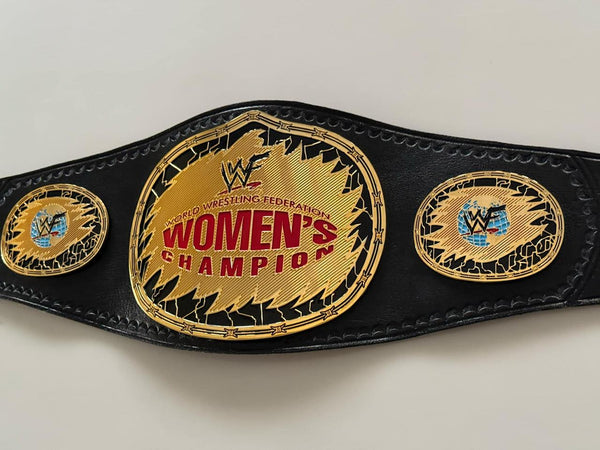
If you would rather have a women's championship you can buy directly, we produce several as standard items, including the classic WWF Women's Champion belt, the AEW Women's World Championship and the NWA World Women's Championship. We are one of a number of makers in this market, so compare on plate thickness and finish rather than on price alone.
For a custom build, start with the custom belt builder or contact us for a quote.
Frequently Asked Questions
When was the Divas Championship created?
It was established on June 6, 2008, with the first champion crowned at The Great American Bash on July 20, 2008, when Michelle McCool defeated Natalya.
Why was the Divas Championship retired?
It was retired at WrestleMania 32 on April 3, 2016, as part of WWE's repositioning of its women's division. The butterfly design and the "Diva" branding were both seen as belonging to an era the company was moving away from. Lita revealed the replacement WWE Women's Championship on the night.
Who was the last Divas Champion?
Charlotte, who won a triple threat against Sasha Banks and Becky Lynch at WrestleMania 32 and became the inaugural WWE Women's Champion in the same match.
Who held the Divas Championship the longest?
Nikki Bella, with a 301-day reign that ended only because the title was retired. AJ Lee holds the record for most combined days at 406 across three reigns.
Why is the Divas Championship belt a butterfly?
The design was intended to be distinctive and to match WWE's "Divas" branding of the period, which emphasised glamour. It drew criticism for suggesting decoration rather than competition, and that criticism was a factor in its eventual retirement.
Can you still buy a Divas Championship belt?
Not usually as a standard catalogue item, since the title has been retired since 2016. It is generally a custom build, and the two things to specify are the pink shade and the plate thickness at the wing edges.
Conclusion
The Divas Championship is the clearest example in wrestling of a belt being an argument. It was designed to say something, it succeeded, and it was retired because what it said had stopped being acceptable.
That history is precisely why it endures as a collectible. A belt that was merely nice would have been forgotten. This one was contested, in both senses, and objects that provoke an argument tend to outlive objects that do not.
If you want one built properly, start a custom belt design and tell us what shade of pink you have in mind.