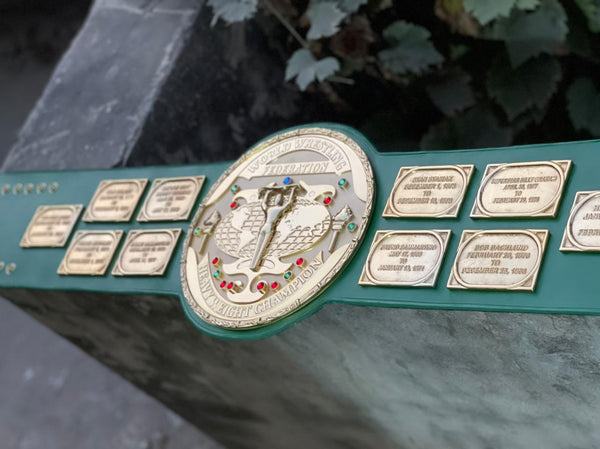
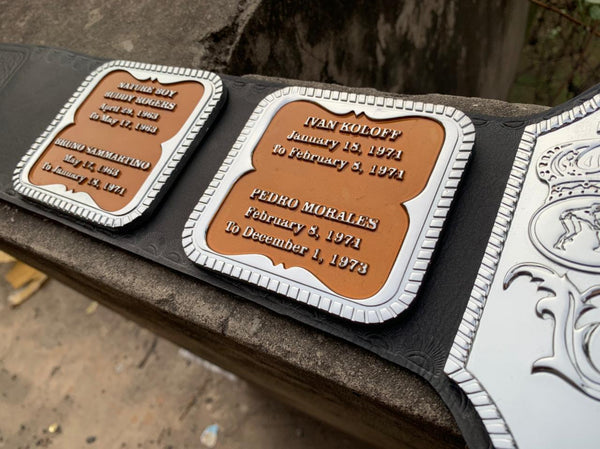
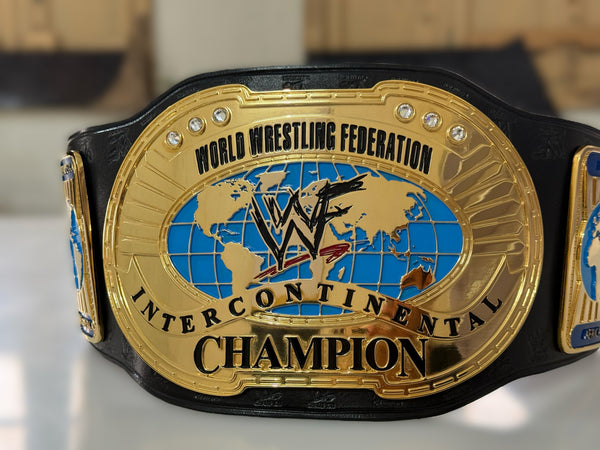
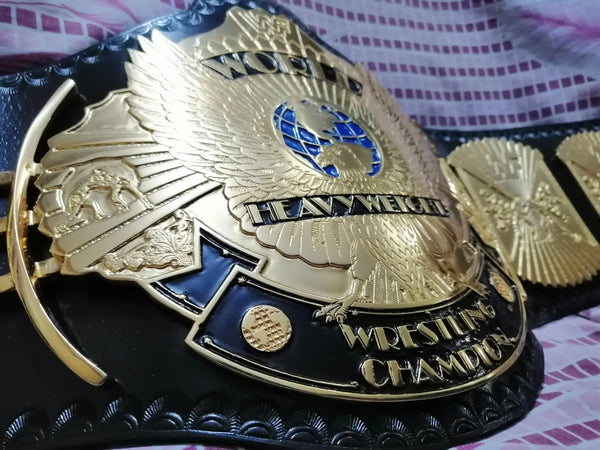
Searching for a WWE Women's Championship belt is more confusing than it should be, because the name has referred to at least three different physical objects across seventy years, and product listings are rarely careful about which one they mean.
There is the original title that ran from 1956 to 2010. There is the one introduced in 2016 to replace the Divas Championship. And there are the brand-specific versions that followed. They look different, they represent different eras, and buying the wrong one is an easy mistake.
This guide sorts out which is which, then covers what to check before you buy. For the butterfly belt that sat between the two eras, see our guide to the Divas Championship belt.
Which Belt Do You Actually Want?
Work this out first and everything else gets easier.
The Classic Title, 1956 to 2010
The original WWE Women's Championship, active for 54 years. This is the belt associated with the Fabulous Moolah, Wendi Richter, Alundra Blayze, Lita and Trish Stratus.
If your reference point is the Attitude Era or the early 2000s, this is your belt. It is also the version with the deepest history, since almost every significant woman in the company's first five decades held it.
It was retired in September 2010 when it was unified into the Divas Championship.
The 2016 Revival
A completely new design introduced at WrestleMania 32 on April 3, 2016, revealed by Lita and first held by Charlotte. It replaced the Divas Championship and signalled the shift in how WWE presented its women's division.
This one looks like a modern WWE world title rather than a distinct women's design, which was deliberate. The point was parity.
The Brand-Specific Versions
Following the 2016 brand extension, the women's title structure split along brand lines, with separate championships for each show and further renames since.
The practical consequence for a buyer is that "WWE Women's Championship" from 2016 onward could mean several different belts. If you want a specific one, check reference images rather than trusting the product name.
The Original Title's History
The 1956 championship is the one worth understanding, because its lineage carries most of the significance.
For decades it was the only women's championship in the company, which made it unusually concentrated. There was no secondary title, no tag division for long stretches, and no brand split. One belt, one lineage.
The Fabulous Moolah's association with it is the defining fact of its early history, with a recognised reign of extraordinary length by any standard. Later holders including Alundra Blayze, Lita and Trish Stratus carried it through the periods most modern fans remember.
Its ending was unusual. Rather than being retired on its own terms, it was absorbed. At Night of Champions in September 2010, Michelle McCool won a unification match and the older title was retired into the newer Divas Championship.
A 54-year lineage was folded into one that had started two years earlier. That is backwards by any normal logic, and it is part of why the 2016 revival felt like a correction.
Women's Championships Beyond WWE
WWE is not the only option, and for a collector the alternatives are often more interesting because they are less reproduced.
AEW has run a women's world championship since its founding, with a design that reads as modern and distinct from WWE's house style. There is also a women's tag team championship.
Ring of Honor maintains its own women's championship, appealing if your interest runs toward the independent scene.
NWA has the World Women's Championship, which carries genuine historical weight given the organisation's age.
We produce all of these as standard items: the AEW Women's World Championship, the AEW Women's Tag Team Championship, the ROH Women's Championship, the NWA World Women's Championship and the classic WWF Women's Champion belt.
If you follow AEW specifically, our AEW championship belt guide covers the wider range.
What to Check Before Buying
The fundamentals are the same as on any championship belt, and they are what separate a display piece from a toy.
- Plate thickness. The fastest tell. Thin plates flex when handled and cannot hold deep engraving.
- Engraving depth. Deep cuts create shadow, which is what makes a plate readable from across a room. Shallow etching disappears.
- Plating evenness. Gold plating over zinc is standard. Poor plating pools in the recesses and flattens contrast.
- Strap. Genuine leather versus synthetic, and enough snaps along the length to sit correctly.
- Weight. A well-built belt is heavy. Light means thin plates, whatever the listing says.
Our breakdown of championship belt materials and craftsmanship goes further into each.
One point specific to this category: women's championship designs have historically used more fine detail and more decorative elements than men's titles of the same period. Fine detail is exactly what cheap reproductions lose first, so engraving depth matters more here than on a plain design.
Custom Women's Belts
Plenty of what we build in this category is not a replica at all.
Women's divisions in regional promotions, gyms running their own titles, and academies awarding a champion of the year all need a belt, and none of them wants a reproduction of somebody else's championship. The requirements are the same as any custom title: a centre plate built to your design, a nameplate that either stays fixed or swaps out depending on whether the belt travels, and artwork clean enough to engrave at plate size.
The one decision worth settling early is the nameplate. If the belt passes from one champion to the next, it needs a replaceable plate designed in from the start, because retrofitting one later means rebuilding the centre plate.
Start with our custom belt builder, or contact us for a quote if you need a set for multiple divisions.
Frequently Asked Questions
What happened to the original WWE Women's Championship?
It was retired in September 2010, when it was unified into the Divas Championship at Night of Champions. It had been active since 1956.
When was the WWE Women's Championship brought back?
At WrestleMania 32 on April 3, 2016. Lita revealed the new design, and Charlotte became the inaugural champion after winning the final Divas Championship match on the same night.
Is the Women's Championship the same as the Divas Championship?
No. They are separate titles with separate lineages and completely different belts. The Divas Championship ran from 2008 to 2016 with a butterfly design. The Women's Championship refers either to the 1956 original or the 2016 revival.
Which women's championship belt should I buy?
It depends on your era. The classic design suits fans of the Attitude Era and early 2000s. The 2016 revival suits followers of the modern product. AEW, ROH and NWA women's titles are worth considering if you want something less commonly reproduced.
Can I get a custom women's championship belt?
Yes. This is common for regional promotions, gyms and academies running their own women's divisions. The main things to specify are the centre plate design and whether the nameplate needs to be replaceable.
Conclusion
The confusion around this title is real and it is not your fault. A championship that ran for 54 years, got absorbed into a two-year-old belt, then came back six years later under the same name was always going to be hard to shop for.
Work out which era you want first, check the reference images rather than the product name, then judge the reproduction on plate thickness and engraving depth.
Browse our women's championship range, read our guide to the butterfly belt era in between, or explore custom belt options if you want a title of your own.